Top 5 Emergency Radios for Power Outages and Storms in the US (2026)
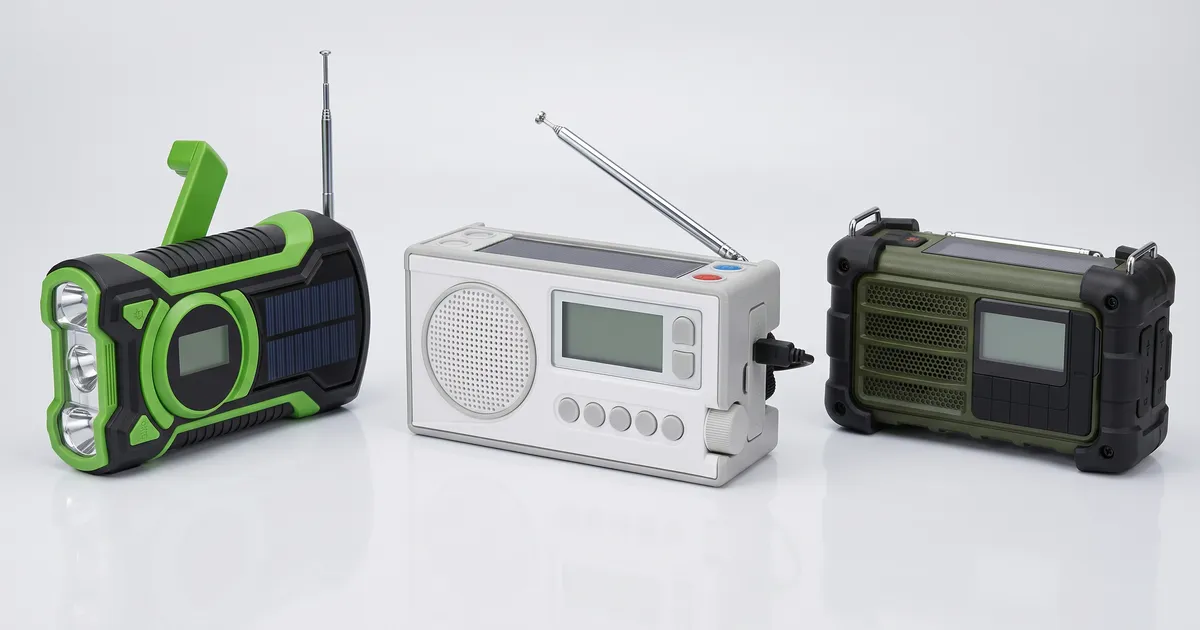
“Radio works great doesn’t really charge that well and using solar doesn’t work definitely needs batteries not really a good item in emergency tried it doing a power failure not good”
— Aklema reynolds · Amazon buyer
When severe weather cuts the power grid, your phone loses signal and the lights go black. In that sudden quiet, an emergency radio becomes your single link to vital storm warnings and civil alerts. You need a device that turns on instantly and pulls in distant broadcast signals without fail.
Choosing the right radio is difficult because so many models look identical on paper. Many mass-market options promise unlimited crank and solar power, yet buyers report that small solar panels barely trickle charge dead cells. Poor internal tuners can leave you with static right when broadcast updates matter most.
We read what buyers report about daily reliability, reception clarity, and emergency power backup. A dependable radio must hold its charge during months of storage and offer multiple ways to stay powered. Understanding these real-world differences helps you secure an alert system you can trust.
How this list was built
The picks on this page combine the editor's designated top selection with models identified by buyer volume and feedback patterns across marketplace listings. What is stated about each unit comes directly from owner experiences, documented technical specifications, and standard industry performance benchmarks.
By the numbers
- Buyers
- 13
- Listings
- 4
- Reviews quoted
- 18
- Picks
- 5
How the shortlist was drawn
- Stock and Marketplace StandingThe first pick was placed by the editor, while subsequent picks were chosen based on buyer volume and review track record on Amazon US.
- Multi-Source Power SystemsEach unit includes at least two independent power methods, such as hand cranks, solar panels, disposable cells, or internal rechargeable batteries.
- Weather Band CapabilityEvery model includes dedicated NOAA or emergency weather frequency reception to deliver immediate hazard notifications.
What each pick was judged on
- Broadcast ReceptionOwners evaluate how cleanly the internal antenna captures AM, FM, and emergency weather frequencies across varying terrain.
- Audio ClarityUsers note whether spoken alerts and emergency bulletins remain audible across noisy living spaces during severe weather.
- Battery LongevityReports track how long internal cells hold standby power during storage and how many hours of continuous runtime they deliver.
- Backup Charging UtilityBuyers assess the practical effectiveness of hand cranks, solar panels, and USB power output for charging essential devices.
- Prices are not listed. They move constantly and a stale number helps nobody — the retailer shows what it costs right now.
Here are the 5, in the editor's order.
The editor placed the first pick. The other picks were chosen by the stated rule from products of the same kind; TrueValuePick earns nothing from any link. How a guide is put together.
Our top 5 picks
No. 1
Sigzivox

This emergency radio is designed for homeowners and outdoor travelers seeking a high-capacity power reserve alongside comprehensive weather band monitoring. Its large internal power bank supplies ample juice for extended broadcast playback and device top-offs during severe storms.
The tough housing carries an IPX5 waterproof rating to shed heavy rain during stormy evacuations. Multiple power options ensure you can maintain continuous operation using solar exposure, hand cranking, or standard USB input during power failures.
Pros
- Offers a large 5000mAh battery capacity for extended radio operation and emergency device charging
- Features IPX5 waterproof construction to endure outdoor wet conditions and rough handling
- Includes real-time NOAA weather broadcast access to monitor developing storm warnings
- Provides versatile power renewal through solar panel, fold-out hand crank, and USB-C connection
- Integrated high-output LED lighting system supplies bright area illumination and emergency signaling
Cons
- Full solar charging requires between 24 and 48 hours of consistent direct sunlight
- Larger internal battery adds slight bulk compared to ultra-compact pocket radios
What to expect
Expect a rugged, dependable emergency tool with multiple backup charging pathways and a bright illumination lamp. It stores enough internal power to run radio broadcasts for days, though topping it off via USB before major weather events remains best practice.
Our conclusion
For anyone preparing a storm kit, this radio provides substantial standby energy and clear emergency illumination. The main trade-off is the lengthy solar recharge duration common to high-capacity internal batteries, making USB wall charging the best way to prep before severe weather.
No. 2
C.Crane Emergency Radio
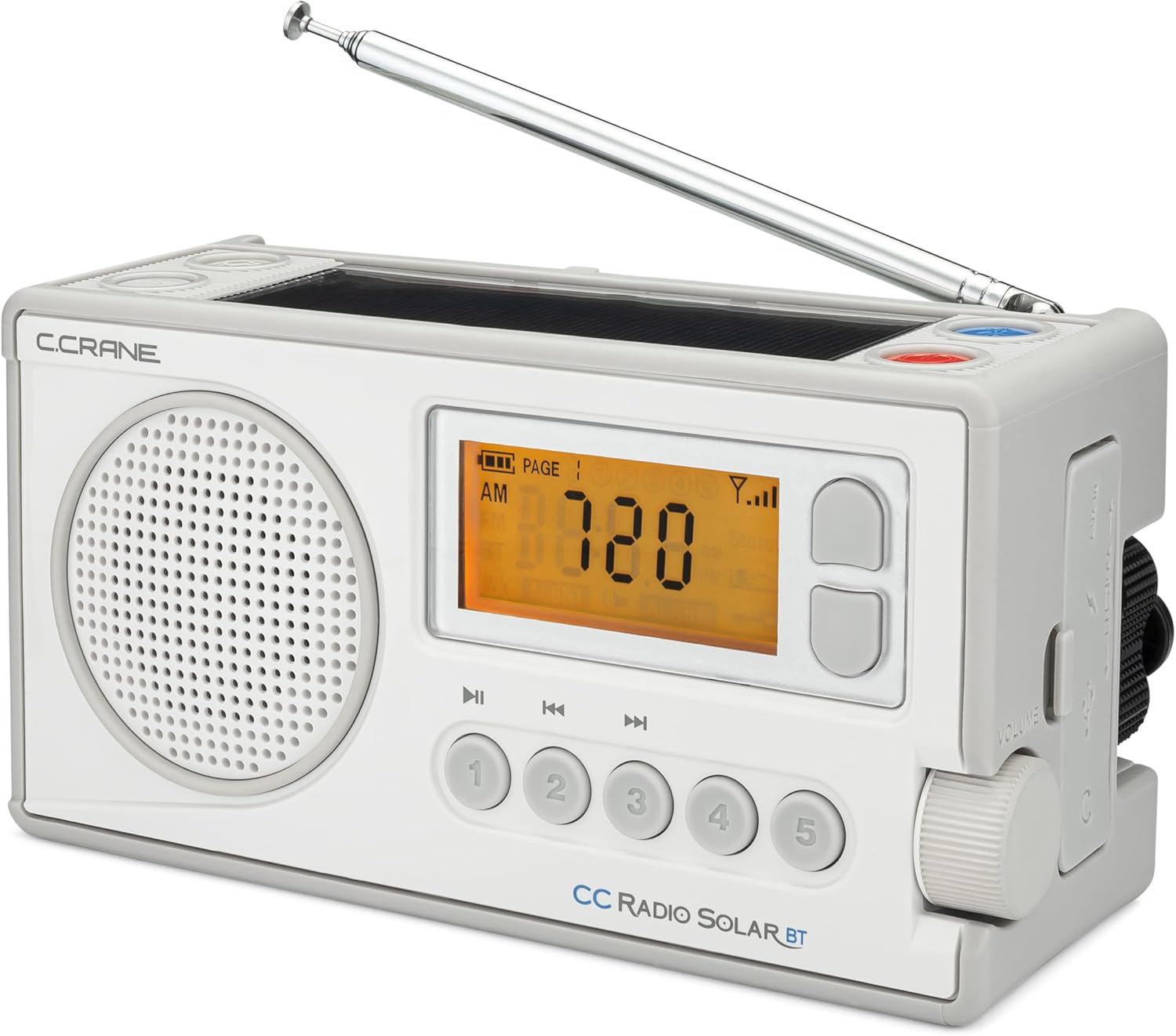
This compact emergency radio suits anyone who values exceptional reception clarity and balanced spoken-word audio during daily use and power outages alike. Owners report that the sensitive tuner pulls in distant AM and FM stations with remarkable precision.
The cabinet features a UV-resistant rubber perimeter that prevents accidental tipping on flat surfaces. A buyer noted the internal cell will last a long time, though the radio stops abruptly when the battery fully depletes.
Pros
- Pulls in faint local and distant radio stations that other compact radios miss
- Delivers clear audio quality tailored for spoken weather reports and music listening
- Provides extended battery life running for up to 50 hours per full charge
- Features solid construction with stable rubber perimeter and well-engineered hand crank
- Stores five station presets per band for fast access during critical weather updates
Cons
- Antenna length is somewhat compact for very weak fringe signals
- Sound output abruptly stops when the battery depletes rather than fading gradually
What owners say
Puppy lover · Amazon buyer
They pull in all my local stations and even some that I could never get before. It's easy to preset your favorite stations and work great for both my AM talk stations and FM music programs.
K in Lonestar state · Amazon buyer
I think it was well thought out in design, and it is not large or heavy. The antenna could be longer. The fit and finish is outstanding.
Our conclusion
This model is ideal for listeners who want exceptional reception clarity and dependable emergency backup. The primary trade-off is that one owner noted the telescoping antenna could be longer for fringe AM reception, but the well-thought-out design ensures reliable emergency broadcasts.
No. 3
Sangean Emergency Radio

This rugged multi-powered radio is engineered for stormy weather, outdoor excursions, and emergency home readiness. Owners report that spoken alerts and music come through with impressive depth and clarity across standard and weather bands.
The internal battery holds standby energy reliably during storage without self-discharging. An integrated hand-crank charger ensures the unit will run even if flat, keeping you connected during unexpected outages.
Pros
- Produces rich, high-clarity audio across spoken bulletins and music broadcasts
- Maintains standby battery charge over long periods of non-use without noticeable self-discharge
- Runs reliably from the hand crank even when the internal battery is completely drained
- Features an IP55 dustproof and water-resistant rugged outer shell for harsh outdoor conditions
Cons
- Solar charging in direct sunlight can cause interference noise on AM frequencies
- Heavier construction than basic pocket emergency receivers
What owners say
Philip Rice · Amazon buyer
The only con and it isn't a deal breaker is while on AM stations and outside in the sunlight, the top mounted solar panel begins to charge and creates a loud squeal in the audio output. Covering up the panel eliminates the squeal.
Wandering Albatross · Amazon buyer
It holds a charge for a long time when not in use. I haven't noticed it to self-discharge at all, though it clearly must since it displays the time 24/7.
Thomas Lento · Amazon buyer
Second, it has three power sources, including a hand-crank charger, which means it will run even if the battery is completely flat.
Our conclusion
This pick suits outdoor enthusiasts and storm preppers needing a dustproof, water-resistant emergency unit. One owner noted that bright sunlight on the solar panel can create a loud squeal on AM frequencies, requiring you to cover the panel while tuning AM stations outdoors.
No. 4
FosPower Emergency Radio

This compact emergency device serves as a lightweight backup receiver, area flashlight, and power bank for camping trips and home blackouts. Owners note that the durable casing survives accidental drops from tables without losing function.
The integrated lamp provides bright emergency lighting for dark rooms and tents. One buyer reported that the internal solar panel doesn't really charge quickly during power failures, making backup AAA batteries essential for extended outages.
Pros
- Pulls in standard broadcast stations cleanly in areas where vehicle tuners struggle
- Durable compact body survives accidental drops and rough outdoor camping use
- Bright LED flashlight and reading light effectively illuminate dark rooms during blackouts
Cons
- Integrated solar panel charges the battery too slowly for rapid blackout recovery
- Compact control knobs can be difficult to operate for users with limited dexterity
- Sound clarity depends heavily on local broadcast signal strength in your area
What owners say
Aklema reynolds · Amazon buyer
Radio works great doesn’t really charge that well and using solar doesn’t work definitely needs batteries not really a good item in emergency tried it doing a power failure not good
MrsPiddles · Amazon buyer
Do not hesitate to get this radio! It ran almost constantly on my camping trip. Picked up a regular radio station where my car couldn't find one.
Mia · Amazon buyer
The light is bright, it is durable (dog accidently knocked off coffee table); the volume & sound quality are dependent on your reception of the NOAA broadcasting.
Kindle Customer · Amazon buyer
All around seems to work ok, only thing it’s for a elderly person, it’s clear volume is great just the knobs are kinda small for her.
Our conclusion
This radio suits campers and budget-conscious preppers who want an all-in-one emergency tool. The main trade-off is that one buyer reported the knobs are small for older users, making backup AAA batteries essential when solar charging proves too slow.
No. 5
RunningSnail Emergency Radio

This portable radio is designed for glove compartments, emergency kits, and travel bags. Reviewers highlight that the small speaker delivers clear, projecting sound that carries well across open rooms.
The built-in LED flashlight offers impressive continuous brightness without dimming over several hours. However, one owner found that charging a phone didn't work from their car dashboard setup.
Pros
- Clear audio projection carries well across rooms despite the compact speaker size
- Strong FM tuner pulls in stations at greater distances than standard home radios
- High-output LED lamp stays bright for hours without dimming
Cons
- Phone charging port may fail to deliver consistent power to modern devices
- Internal battery and charging components may fail after several years of storage
- Analog dial requires careful manual adjustment to isolate faint stations
What owners say
jennyhomemade-20 · Amazon buyer
It's a very bright LED light and I just left it on facing the wall while we watched tv. It never dimmed at all and after about 2.5 hours I went to bed and had to turn it off.
Jeff Davis II · Amazon buyer
I keep the product in my dashboard in my car so that it can charge I tried to charge my phone with it it didn't work but I'm going to try it again
Metamorphic Rocker · Amazon buyer
For such a small speaker, sound is very clear and, at appropriate volume, can be heard from a good distance away. It seems to pick up signals better--or, more precisely, with a longer, stronger range-- than my larger, non-emergency radio, particularly on the FM frequency where I do most of my dialing.
Kindle Customer · Amazon buyer
It stopped working or charging entirely at about year three. I know I cant expect things to last forever, but that seemed like a pretty short lifespan.
Our conclusion
This lightweight unit suits drivers and minimalist preppers who need basic lighting and alerts. The main trade-off is a reported short lifespan of roughly three years, though its strong FM reception range delivers reliable news during local storms.
Buying guide
Primary Power and Battery Capacity
A dependable emergency radio relies on multiple charging pathways so you never get stranded without power. Internal lithium-ion packs offer generous runtimes for casual listening and emergency lights, but they eventually deplete during prolonged blackouts. Models that accept standard disposable batteries give you instant backup power when wall outlets remain dark.
Crank generators and solar panels serve as vital emergency fallbacks rather than daily primary chargers. A hand crank can generate emergency runtime with a few minutes of steady winding. Solar panels maintain passive charge when placed near a window, though full recharging through sunlight requires considerable time.
Reception and Frequency Support
Access to NOAA weather broadcasts ensures you receive immediate storm watches, flood warnings, and civil alerts. Look for digital tuners or clear analog dials with responsive fine-tuning to lock onto weak transmission towers during heavy cloud cover. A telescoping antenna helps pull faint AM talk stations and distant weather signals out of the noise floor.
Mistakes buyers keep making
Drawn from what buyers complain about in their reviews.
• Relying solely on solar power for primary charging: Small integrated panels require dozens of hours of direct sunlight to fill a depleted battery, making them emergency maintainers rather than fast daily chargers. • Ignoring standby battery drain during storage: Rechargeable batteries lose charge over several months of sitting in a closet, which leaves you without power unless you top them up periodically. • Expecting full smartphone charges from mini power banks: Built-in batteries on compact radios often supply only a partial top-up for modern smartphones rather than a complete recharge. • Overlooking control ergonomics for quick adjustments: Tiny dials and cramped knobs can prove difficult to adjust in total darkness or when handled by older family members during emergencies.
Frequently asked questions
How was this list of emergency radios chosen?
The first pick is the editor's pick. The remaining models were chosen based on purchase volume and review activity, listed new and in stock on Amazon US.
Can the hand crank fully recharge a dead radio battery?
Cranking is designed to produce short bursts of power for critical broadcasts and lighting, as filling a large internal battery by hand requires several hours of continuous winding.
How long will an emergency radio hold its charge in storage?
Most lithium batteries maintain usable power for several months, though checking and topping up the battery every three to six months ensures readiness for sudden storms.
Can these radios charge modern smartphones during an outage?
Most models provide enough power through their USB output port for emergency calls and basic communication, though compact batteries rarely deliver multiple full phone charges.
Why is NOAA weather band reception essential?
NOAA frequencies broadcast continuous local weather updates, storm warnings, and hazard bulletins directly from government meteorological stations even when cellular networks fail.
What is the benefit of having disposable battery backup?
Standard alkaline batteries allow you to swap in fresh power instantly during extended grid failures without needing sunlight or manual hand cranking.

Travis Lund
Editor, Outdoor & Camping guides
Travis Lund covers outdoor and camping gear for TrueValuePick, building each guide from what owners report in public about the tents, packs and camp gear they carry.
Compiled this guide from buyer reviews, each one checked against an archived copy of the listing it came from.